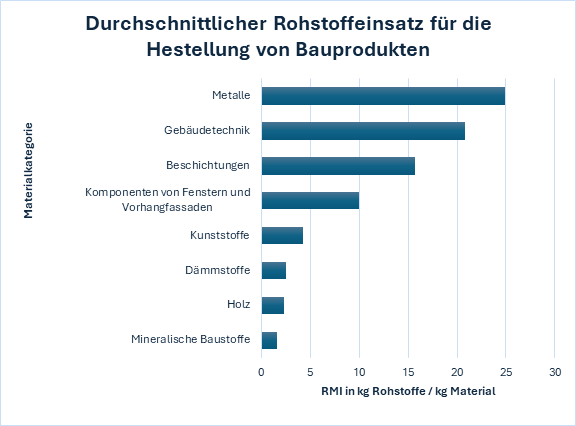
Material footprint in construction: RMI and TMR demystified
How much raw material is in our products and buildings? - This is a question that is becoming increasingly important, as the use of raw materials and environmental impacts such as climate change and biodiversity loss are closely linked. The RMI and TMR are key indicators that together measure the material footprint of a product or construction project and help to measure the use of raw materials across the entire life cycle.
Why are raw materials worth protecting?
Raw materials are among the natural resources that, along with water and soil, are protected under the ISO 14040 life cycle assessment standard and are protected by EU environmental law. But why are they worth protecting?
-
- Limited availability: Many raw materials, especially fossil and mineral resources, are only available in limited quantities or are only renewed very slowly. Inconsiderate use can lead to bottlenecks in the future.
-
- Environmental damage caused by extraction and processing: The extraction, processing and disposal of raw materials are often accompanied by considerable interference with nature and lead to the release of emissions, landscape loss, soil damage and loss of biodiversity. According to the International Resource Panel, the extraction and processing of raw materials accounts for 50% of greenhouse gas emissions and 90% of biodiversity loss globally(IRP 2019).
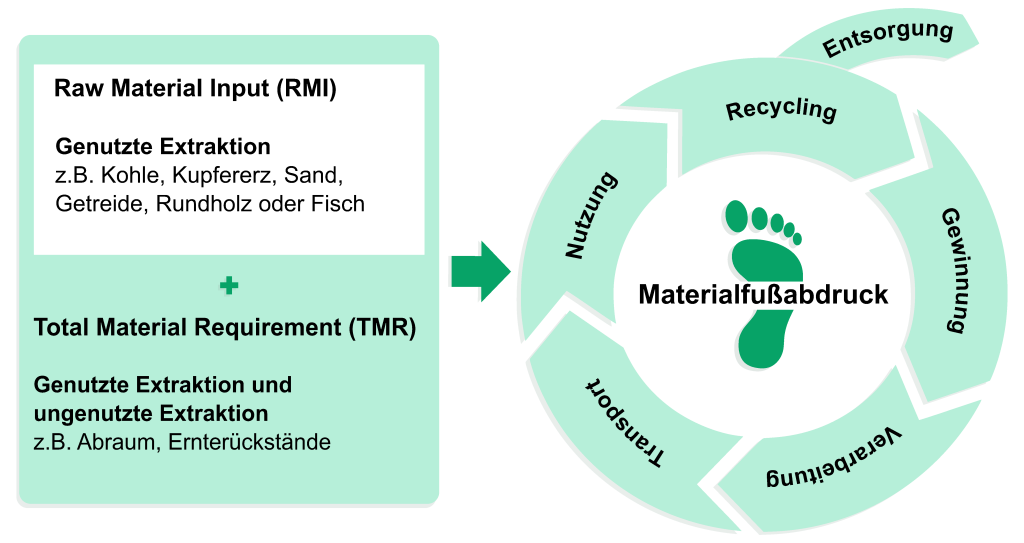
What is the material footprint and how is it measured?
The material footprint helps us to understand how much raw material a product, a building or an entire nation uses. The two most important key figures here are
-
- RMI (Raw Material Input): RMI measures how much raw material actually goes into production, use and disposal. It shows the "used" material input and answers the question: How much raw material is used for a product?
-
- TMR (Total Material Requirement): TMR goes one step further and also includes the "unused" raw materials, such as overburden or other masses that have to be moved to get to the desired raw materials. This often includes hidden environmental impacts such as landscape change or energy consumption from moving large masses.
The material footprint takes into account the extraction of abiotic and biotic raw materials and primary materials from nature and their use or deposition as unused material. Abiotic raw materials originate from the earth's crust and include fossil raw materials (e.g. crude oil, natural gas, coal), metals and their ores (e.g. iron, copper, aluminum) and mineral raw materials (e.g. sand, gravel, limestone, gypsum). Biotic resources, on the other hand, consist of natural and cultivated biomass, such as wood, crops (e.g. maize, wheat) and animals, which are used as a source of food or for other purposes.
The material footprint at product level
At product level, the material footprint provides an overview of the total raw material input for an individual product. This is particularly important as it shows which products are particularly resource-intensive.
-
- Example: While around 40 tons of raw materials are required to produce one ton of aluminium without the use of recycled aluminium, this figure is reduced to around 17 tons for an aluminium alloy with 30% recycled aluminium.
-
- Influence on product design: The material footprint can influence the design of products by favoring resource-saving materials or recyclable components.
In the "Raw material use in ÖKOBAUDAT" project, we calculated the material footprints of over 600 construction products and construction processes. You can find out more in the article Raw material use in ÖKOBAUDAT: Transparency in the construction industry.
From product to building: resource efficiency in the construction industry
At building level, the material footprint is also becoming an important indicator for resource-efficient construction. The entire life cycle of a building is considered here.
-
- Why is this important? A high material footprint means that a lot of resources go into a construction project. The footprint can be reduced through the efficient use of resources and the use of recycled materials.
-
- Practical approaches: Urban mining, i.e. the recycling of materials from old buildings, and durable construction methods help to reduce the use of materials. Example projects such as the Korbach town hall made of R-concrete and the "Sufficiency House U10" in Uhlandstraße in Kassel already show how the circular economy can succeed in the construction industry.
The big picture: material footprint and the SDGs
At an economic level, the material footprint plays a key role in the Sustainable Development Goals (SDGs), particularly in Goals 8 and 12:
-
- SDG 8 (Economic growth and decent work)
-
- SDG 12 (Sustainable consumption and production patterns)
At a macroeconomic level, raw material consumption (RMC) is used, which indicates the RMI for materials used domestically and thus enables international comparisons.
According to EUROSTAT, Germany's RMC in 2023 was 13.7 tons per capita, just below the European average of 14.1 tons per capita for the first time since the start of the survey (2014). According to calculations by international organizations such as the International Resource Panel and the World Economic Forum, a global primary raw material consumption of 6 to 8 tonnes per person per year is considered compatible with planetary boundaries. The proposal in the National Circular Economy Strategy (draft version 17.06.2024) is based on this, according to which an RMC of 8 tons per capita is targeted by 2045.
Limits of the material footprint and possible additions
The material footprint shows how much raw material is used, but says nothing about specific impacts on people or the environment. Such indicators are referred to as midpoint indicators. Endpoint indicators, on the other hand, go further and show direct effects on health or nature.
Additional indicators and qualitative approaches such as the FSC standard for wood products can fill such gaps and help to include social and environmental aspects in the assessment.
Thinking resources and climate together!
The material footprint in the construction industry provides information on how many and which raw materials are required for buildings and their components, thus providing a crucial basis for sustainable decisions. By measuring the material footprint of buildings, we can precisely track the use of raw materials and introduce targeted measures for reduction and optimization. This approach supports resource efficiency throughout the entire life cycle of a building - from raw material extraction and construction production to use, dismantling and recycling. To ensure that climate protection and resource efficiency go hand in hand, we recommend looking at the material footprint and the climate footprint together, analyzing possible conflicting goals and making truly informed decisions!
Do you have any questions or comments on this topic? We look forward to your feedback! Send us a message about this article using our contact form.
You can find more information about the material footprint here: