Raw material consumption in ÖKOBAUDAT: Transparency in the construction industry
Sustainability in the construction industry is becoming increasingly important, and ÖKOBAUDAT plays a central role in this. The Federal Government's database provides extensive information on the environmental impact of construction products and construction processes. In collaboration with the University of Kassel, SURAP GmbH has developed new data as part of the project "Raw material consumption in ÖKOBAUDAT" in order to make resource consumption in the construction industry even more transparent and measurable. The complete final report provides detailed insights into methods and results and is freely available here.
ÖKOBAUDAT: A key to life cycle assessment in the construction industry
ÖKOBAUDAT is a central point of contact for construction and planning companies as well as architects who want to build in an environmentally friendly way. As an official database of the Federal Government, it serves as an important basis for the Assessment System for Sustainable Building (BNB) and the Quality Seal for Sustainable Building (QNG). By providing comprehensive environmental information, it helps to make the use of raw materials and energy in construction projects transparent and to promote resource-conserving construction methods.
The "Raw material expenditure in ÖKOBAUDAT" project
With the aim of making resource consumption in the construction industry more efficient, the project developed comprehensive data sets for construction products and construction processes. The focus is on two important indicators:
-
- Raw Material Input (RMI): This indicator measures the total amount of raw materials used throughout the life cycle (i.e. in the manufacture, use and disposal) of a product.
-
- Total Material Requirement (TMR): The TMR records the amount of primary material removed from or moved in nature, both used and unused material.
Both indicators can be disaggregated into abiotic components (fossil raw materials, metals, mineral raw materials) and biotic components (wood, agricultural raw materials, aquatic raw materials) for detailed insights. At building level, the RMI and TMR can help to document and optimize the raw material requirements of a building from the outset and provide "building resource passports" with quantitative raw material indicators. Both indicators are already recognized as additional indicators in the Building Resource Passport of the German Sustainable Building Council (DGNB). The indicators not only create transparency at product level, but also make it possible to compare raw material consumption across Germany, Europe and the world and thus set benchmarks.
At a macroeconomic level, raw material consumption (RMC) is used, which indicates the RMI for materials used domestically and thus enables international comparisons.
A first insight into the results
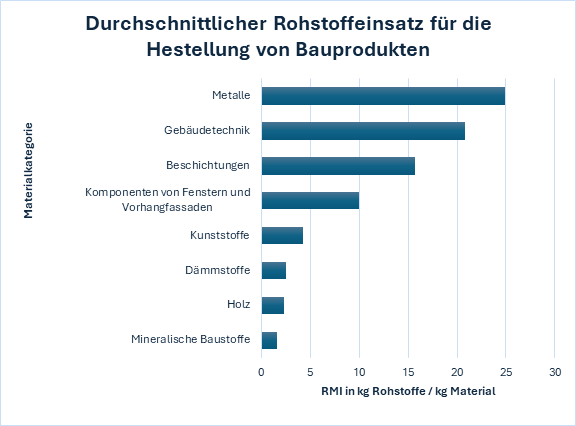
The data sets created in the project already provide exciting insights into the resource consumption of different material categories. An example graph shows that the average RMI values (Raw Material Input) vary greatly depending on the material category. These values illustrate how different the use of resources can be in the construction industry - and how important it is to take ecological factors into account when selecting materials.
Thinking climate and resources together. The key to a complete climate and raw materials balance in the construction industry
The "Raw material consumption in ÖKOBAUDAT" project makes a decisive contribution to a transparent and resource-conserving construction industry. With the RMI and TMR indicators, construction companies and planners have a practical basis for making the use of raw materials in the construction industry tangible in addition to the climate impact - a real step towards future-oriented construction. It will be exciting to see how these approaches change the way resources are used in the construction industry and what new opportunities they open up for construction projects!
Do you have any questions or comments on this topic? Do you have any questions or comments on this topic? We look forward to your feedback! Send us a message about this article using our contact form.
You can find out more about the material footprint in the blog post Material footprint in the construction industry: RMI and TMR demystified