Material footprint in construction: RMI and TMR demystified
Material Footprint in Construction: RMI and TMR Explained Simply
How much raw material is contained in construction products and buildings? We explain the RMI, TMR, and RMC indicators, present figures for Germany and the EU, and contextualize the goals of the National Circular Economy Strategy.
The material footprint indicates how many primary raw materials are extracted from nature for a product, a building, or an economy over its entire life cycle. It is measured using the RMI (Raw Material Input, raw materials used) and the TMR (Total Material Requirement, additional unused extraction such as waste rock).
The use of raw materials and environmental impacts such as climate change and biodiversity loss are closely linked. Therefore, anyone in the construction industry who wants to plan in a resource-efficient manner needs to consider not only the carbon footprint but also the material footprint.
Why are raw materials worth protecting?
Along with water and soil, raw materials are among the natural resources that are considered protected assets under the ISO 14040 life cycle assessment standard and are protected under EU environmental law. There are two reasons for this:
Limited availability
Many natural resources, especially fossil fuels and minerals, are available only in limited quantities or are replenished very slowly. Careless use will lead to shortages in the future.
Environmental Damage Caused by Mining and Processing
Extraction, processing, and disposal result in emissions, land use, soil degradation, and loss of biodiversity.
are attributable to the extraction and processing of raw materials (International Resource Panel 2019).
RMI and TMR: What's the difference?
The material footprint shows how much raw material a product, a structure, or an entire economy consumes. The two most important metrics build on one another:
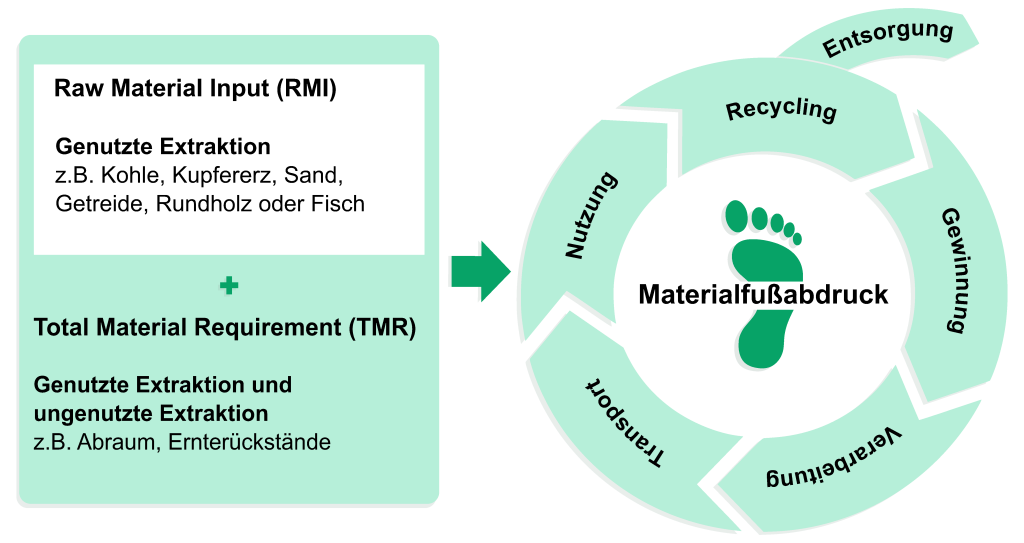
The amount of raw materials used, including all upstream supply chains. The RMI answers the question: How much raw material is actually used in a product?
RMI plus unused extraction: overburden and other materials that must be moved to access the raw material. This reveals hidden environmental impacts, such as changes to the landscape or the energy required to move large volumes of material.
| Indicator | What it covers | Typical Level |
|---|---|---|
| RMI | Primary raw materials used, including upstream supply chains | Product, Building |
| TMR | RMI plus unused output (e.g., overburden) | Product, Building |
| RMC | RMI minus exports in commodity equivalents | Economics |
This category covers the extraction of primary raw materials from nature. Abiotic raw materials come from the Earth’s crust: fossil fuels (crude oil, natural gas, coal), metals and ores (iron, copper, aluminum), and mineral raw materials (sand, gravel, limestone, gypsum). Biotic raw materials are natural and cultivated biomass, such as wood, crops, and animals.
Material Footprint of Construction Products
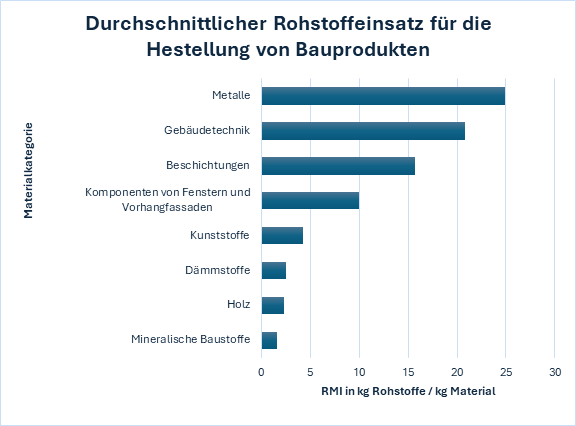
At the product level, the material footprint shows the total amount of raw materials used in a single product. This highlights resource-intensive building products. It also influences product design—for example, by favoring resource-efficient materials, higher recycling content, or recyclable components.
As part of the research project “Raw Material Use in ÖKOBAUDAT,” we calculated the material footprints of over 600 building products and construction processes. Read more about this in the article “Raw Material Use in ÖKOBAUDAT: Transparency in the Construction Industry.”
Material Footprint of Buildings
At the building level, the material footprint serves as an indicator of resource-efficient construction, considered over the entire life cycle. A high value means that a large amount of resources is used in a construction project. Here’s how to reduce it:
- Urban Mining: Reusing materials and components from existing buildings.
- Recycled materials: For example, use R-concrete with recycled aggregate.
- Durable Construction Methods: Extend Service Life, Reduce Replacement Cycles.
Example projects such as the Korbach City Hall, built with R-concrete, and the U10 Sufficiency House in Kassel demonstrate how a circular economy can be successfully implemented in the construction industry. You can calculate a building’s material footprint directly within the model using the SURAP Revit® plugin or in the SURAP web tool.
RMC, the SDGs, and the National Circular Economy Strategy
At the macroeconomic level, Raw Material Consumption (RMC) is used: the RMI minus exports in raw material equivalents. It captures the raw materials extracted worldwide for a country’s consumption and investment, and allows for comparisons between countries. It is established as an indicator in the Sustainable Development Goals, specifically in SDG 8.4.1 (Economic Growth) and SDG 12.2.1 (Sustainable Consumption and Production).
According to calculations by the International Resource Panel, global primary raw material consumption of 6 to 8 metric tons per person per year is considered compatible with planetary boundaries. The National Circular Economy Strategy (NKWS), which the federal government adopted on December 4, 2024, is based on this figure. It sets a goal of reducing raw material consumption to 6 to 8 metric tons per capita by 2045.
Good to know: The NKWS’s goal is a guiding principle, not a binding target. The strategy does not include an interim target for 2030, a point that environmental organizations have criticized. For the construction industry, however, the guiding principle is still an important benchmark, as mineral-based building materials account for a large portion of raw material consumption.
Limitations of the Material Footprint
The material footprint shows how much raw material is used. It says nothing about specific impacts on people and the environment. Therefore, it should be supplemented:
Midpoint Indicators
Measure a quantity along the value chain, such as metric tons of raw materials. This includes the material footprint.
Endpoint Indicators
Indicate direct effects on health, ecosystems, or resource availability.
Qualitative Additions
Standards such as FSC for wood products address gaps in social and environmental considerations.
Conclusion: Thinking About Resources and Climate Together
The material footprint shows how many and which raw materials are needed for buildings and their components. By measuring it, one can track raw material use and reduce it in a targeted manner—from raw material extraction through manufacturing and use to demolition and recycling.
To ensure that climate protection and resource efficiency go hand in hand, we recommend considering the material footprint and the carbon footprint together. This helps identify conflicting goals and enables well-informed decisions to be made.
Frequently Asked Questions About the Material Footprint
What is the material footprint?
The material footprint indicates how many primary raw materials are extracted from nature for a product, a building, or an economy over its entire life cycle. It is expressed in metric tons, usually as RMI or TMR.
What is the difference between RMI and TMR?
The RMI (Raw Material Input) tracks the raw materials used, including upstream materials. The TMR (Total Material Requirement) also includes unused material removed—such as overburden—that must be moved to access the raw material.
What does RMC stand for?
RMC (Raw Material Consumption) is the raw material consumption of an economy: RMI minus exports in raw material equivalents. It is an indicator for SDGs 8.4.1 and 12.2.1.
What is the goal of the National Circular Economy Strategy?
The National Raw Materials Strategy (NKWS), adopted in December 2024, sets forth the goal of reducing raw material consumption in Germany to 6 to 8 metric tons per capita per year by 2045. This target is not binding.
How do I calculate a building's material footprint?
The calculations are based on the quantities of all building materials and the characteristic values of raw materials for each product, such as those from ÖKOBAUDAT. Using the SURAP Revit® plugin or the SURAP web tool, the material footprint can be calculated directly from the building model.
Further Reading
- Determining the Material Footprint Using Life Cycle Assessment Methods and Software Solutions (Bringezu et al. 2019)
- Applicability of Indicators for Cumulative Raw Material Expenditures in the BNB and QNG (Mostert et al. 2024)
- Raw Material Input in ÖKOBAUDAT (Glanz et al. 2024)
Do you have any questions or comments? Please contact us using our contact form.
Calculate the material footprint directly within the building model
With the SURAP Revit® plugin and the web tool, you can assess the life cycle assessment and raw material consumption for each material, component, and building.